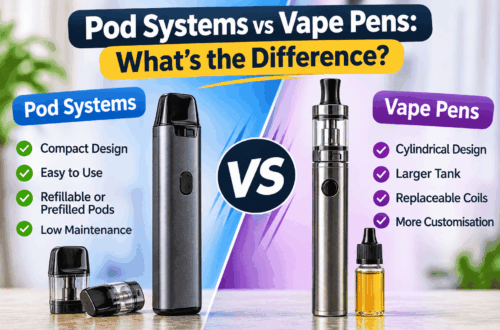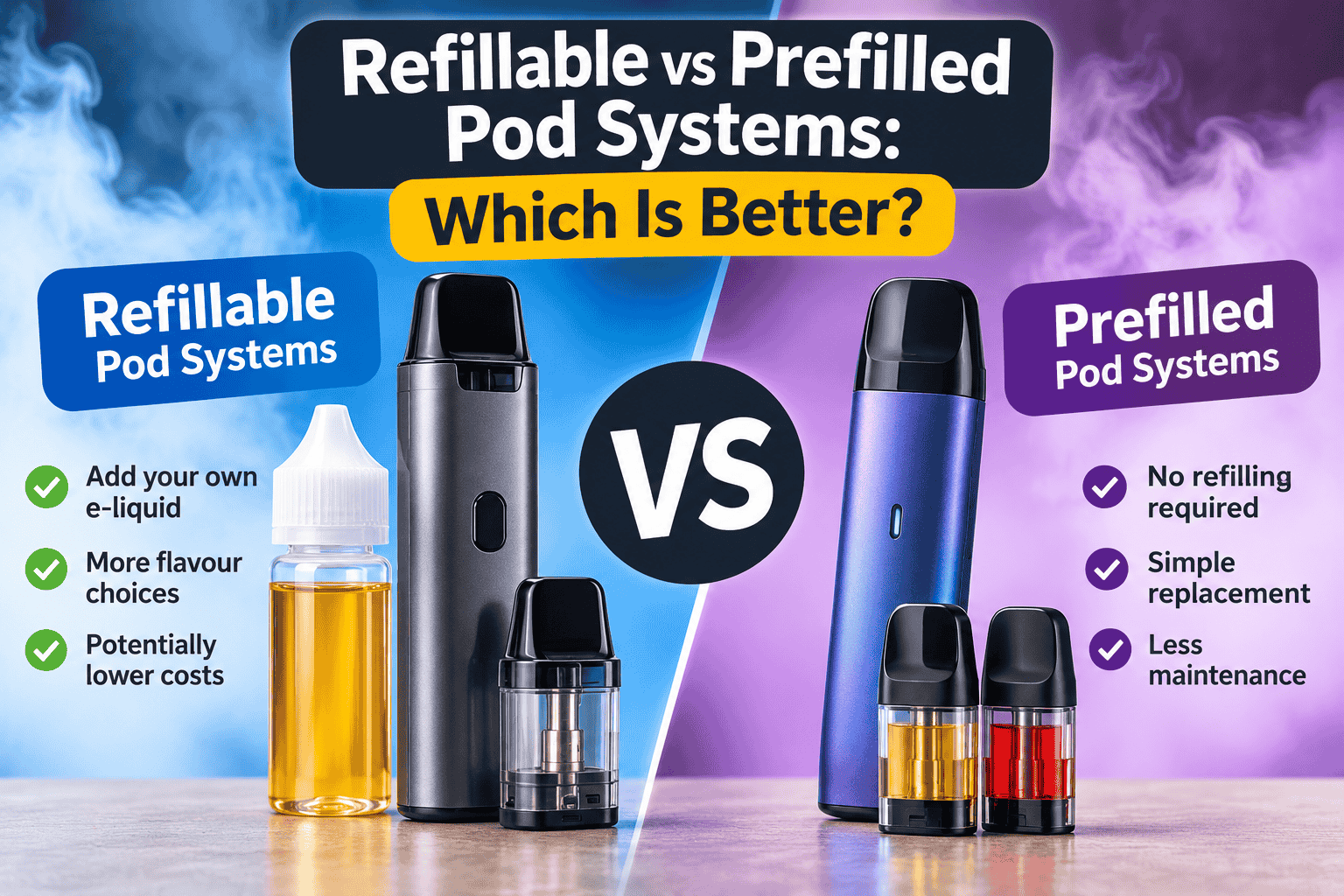
Pod systems have become an established part of the vaping market, offering a compact alternative to larger vape kits. They are available in different designs, but two types are particularly common: refillable pod systems and prefilled pod systems.
Although both use a small pod or cartridge to hold e-liquid, they work differently. Refillable devices allow users to add their own e-liquid, while prefilled systems use cartridges that arrive with e-liquid already inside. Once a prefilled cartridge is empty, it is replaced with another compatible one.
The difference may seem straightforward, but it affects several aspects of everyday use, including convenience, running costs, flavour selection, maintenance and waste. A device that suits someone who prefers minimal maintenance may not be the right choice for someone who values flexibility.
This guide explains how both types work, where they differ and what adults should consider before choosing between them.
What Is a Refillable Pod System?
A refillable pod system is a vaping device that uses a removable cartridge designed to be filled with e-liquid. Instead of replacing the entire pod whenever the liquid runs out, the user opens a filling port, adds compatible e-liquid and continues using the cartridge until its coil or other components need replacing.
Most refillable pod systems consist of three main components:
- Battery: Supplies power to heat the coil and produce vapour.
- Refillable pod: Holds the e-liquid and connects to the battery.
- Coil: Heats the e-liquid to produce an aerosol.
Some devices have built-in coils, meaning the entire pod must be replaced when the coil reaches the end of its useful life. Others use replaceable coils, allowing the user to keep the cartridge and change only the heating element.
Refillable systems are available in several formats, from simple draw-activated devices to adjustable models with different power settings and airflow controls.
One of their main characteristics is compatibility with different e-liquid formulations. Depending on the device manufacturer’s specifications, users may be able to choose between different flavours, nicotine strengths and e-liquid compositions.
However, not every e-liquid is suitable for every pod. Coil resistance, wicking design and the manufacturer’s recommendations should be considered before selecting a liquid.
What Is a Prefilled Pod System?
A prefilled pod system uses cartridges that are supplied with e-liquid already inside. The cartridge is manufactured to work with a particular device or product range, so users do not need to fill it manually.
When the e-liquid is depleted, the user removes the empty cartridge and installs a compatible replacement.
A typical prefilled pod system includes:
- A rechargeable battery or power unit.
- A sealed or factory-filled pod.
- An integrated or manufacturer-specified coil.
- A connection mechanism that attaches the pod to the device.
Some prefilled systems have removable pods, while others use closed cartridges that cannot be opened or refilled under normal operating conditions.
The main appeal is simplicity. There is no need to purchase separate e-liquid bottles, measure liquid or deal with filling ports. The device is designed to work with its intended replacement cartridges.
However, users generally have less freedom when choosing e-liquid. They are limited to the flavours, nicotine strengths and formulations made available for the compatible pod range.
Refillable vs Prefilled Pod Systems: Key Differences
Both systems use a pod-based design, but their ownership experience is quite different.
The following table highlights their main differences.
| Feature | Refillable Pod System | Prefilled Pod System |
|---|---|---|
| E-liquid | Added manually | Supplied inside the pod |
| Refilling | Required | Not normally required |
| Replacement | Pod or coil, depending on design | Prefilled cartridge |
| Flavour selection | Depends on compatible e-liquids | Limited to available cartridges |
| E-liquid flexibility | Generally higher | Generally lower |
| Maintenance | Requires regular cleaning and care | Usually minimal |
| Initial setup | May require filling | Usually straightforward |
| Running costs | Depends on liquid and replacement parts | Depends on cartridge prices |
| Compatibility | Device-specific pods and coils | Usually brand or model-specific |
| Waste | Empty bottles and used pods | Used cartridges |
The most important distinction is flexibility versus simplicity. Refillable systems provide greater control over e-liquid selection, whereas prefilled systems reduce the number of steps involved in everyday use.
1. Convenience and Ease of Use
Convenience is one of the biggest differences between these two types of pod systems.
Refillable pod systems
Refillable devices require some involvement before they are ready to use. The user needs to open the filling port, add the correct e-liquid and allow sufficient time for a new or recently replaced coil to become saturated.
The process is not particularly complicated, but it does require attention.
Users also need to carry an e-liquid bottle if they expect to refill the device away from home. Spills can occur when the pod is overfilled, the filling seal is damaged or the wrong filling procedure is followed.
On the other hand, once the pod is filled, everyday operation is generally straightforward.
Prefilled pod systems
Prefilled devices remove the manual filling process. The cartridge already contains e-liquid, so users simply install a compatible replacement when needed.
This design reduces the number of steps involved in maintaining the device. There are no separate e-liquid bottles to manage and no routine filling process.
For adults who prefer a straightforward device with fewer maintenance requirements, this arrangement can be appealing.
The difference: Prefilled pods offer a simpler replacement process, while refillable pods require more involvement but provide greater control over the liquid being used.
2. Cost and Long-Term Expenses
Price is another important consideration, particularly for adults comparing the ongoing cost of different pod systems.
However, it is important to distinguish between the initial purchase price and the cost of continued use.
Refillable pod systems
A refillable device may require an initial investment in the battery unit, compatible pods, e-liquid and replacement coils.
After the initial purchase, ongoing expenses depend on how frequently the device is used and which components need replacing.
The user purchases e-liquid separately and replaces pods or coils according to their condition and the manufacturer’s recommendations.
The total cost is influenced by:
- The price and size of e-liquid bottles.
- How frequently e-liquid is used.
- The lifespan of the pod and coil.
- The price of replacement components.
- The availability of compatible accessories.
Although refillable systems can offer a different cost structure, they are not automatically cheaper in every situation.
Prefilled pod systems
Prefilled systems generally require users to purchase replacement cartridges when the existing ones are empty.
The price of each cartridge and the number of pods used over time determine the ongoing expense.
Some manufacturers sell replacement cartridges individually, while others offer multipacks. Actual costs vary considerably between brands and models.
A fair comparison should consider the total cost over a consistent period rather than looking only at the price of the starter kit or one replacement pod.
The difference: Refillable systems separate the cost of e-liquid from replacement hardware, while prefilled systems combine the e-liquid and cartridge into one purchase. Which arrangement costs less depends on the specific products and usage patterns.
3. Flavour Selection and E-Liquid Options
Flavour availability is another area where the two systems differ.
Refillable pod systems
One of the main characteristics of refillable devices is their ability to work with different compatible e-liquids.
Depending on the manufacturer’s specifications, available choices may include:
- Fruit-inspired flavours.
- Mint and menthol varieties.
- Dessert-inspired flavours.
- Tobacco-style flavours.
- Different nicotine strengths and nicotine-free formulations.
Users can also change e-liquid brands without necessarily changing their device, provided the formulation is suitable for the pod and coil.
However, e-liquid compatibility matters. A liquid that is too thick for a particular pod may not wick properly, potentially causing dry hits or premature coil damage.
Prefilled pod systems
Prefilled devices offer a more restricted selection because the available flavours are determined by the manufacturer.
The advantage is consistency within a compatible product range. The cartridge is designed for its intended device, and users do not need to choose a separate liquid formulation.
The disadvantage is that a preferred flavour or nicotine strength may not be available for every model.
The difference: Refillable pods provide more e-liquid choice, while prefilled pods limit selection to the manufacturer’s compatible cartridge range.
4. Maintenance and Cleaning
Maintenance affects how a pod system performs over time. Both types need reasonable care, although the work involved is different.
Maintaining refillable pod systems
Refillable devices need regular attention because e-liquid comes into direct contact with the pod, filling seals and coil assembly.
Common maintenance tasks include:
- Checking the pod for cracks or damaged seals.
- Cleaning small amounts of spilled e-liquid.
- Keeping the electrical contacts free from residue.
- Checking for signs of leaking.
- Replacing worn or damaged pods.
- Following the recommended coil replacement procedure.
Some refillable pods have replaceable coils, while others require the entire cartridge to be changed. This distinction can affect both maintenance and replacement expenses.
It is also important not to continue using a pod that has developed persistent leakage or visible damage.
Maintaining prefilled pod systems
Prefilled systems generally require less cleaning because users do not handle loose e-liquid during normal cartridge replacement.
Basic maintenance still matters. The battery contacts should be kept clean and dry, the device should be stored according to manufacturer instructions, and damaged cartridges should be replaced.
A prefilled cartridge should not be forced open or modified if it is designed as a sealed unit.
The difference: Refillable devices require more attention to filling, seals and e-liquid residue. Prefilled devices reduce these tasks but still need routine inspection and proper handling.
5. Battery Life and Device Performance
It is easy to assume that one pod type automatically offers better battery performance than the other. In reality, the battery and power-management design have a much greater influence.
Both refillable and prefilled pod systems are available with different battery capacities, charging arrangements and output levels.
Battery performance depends on several factors:
- Battery capacity, measured in milliampere-hours (mAh).
- Power output and operating voltage.
- Coil resistance.
- Frequency and duration of use.
- Battery age and charging condition.
- Device efficiency.
For example, a compact prefilled device may have a smaller battery than a larger refillable model. However, another prefilled model may have a battery capacity comparable to a refillable alternative.
The same applies to vapour production. Coil design, airflow, power output and e-liquid formulation all contribute to the device’s operation.
For this reason, battery life and performance should be compared using the specifications of individual devices rather than the pod category alone.
6. Environmental Impact and Waste
The environmental impact of vaping products is an increasingly important subject, particularly because electronic devices contain materials that should not be disposed of with ordinary household rubbish.
Refillable pod systems
Refillable systems allow users to keep the same battery unit and refillable cartridge for a period of time, replacing components when necessary.
Depending on the design, this may reduce the number of complete cartridges discarded compared with a system that requires a new prefilled pod each time.
However, refillable systems still generate waste through empty e-liquid bottles, worn coils, used pods and electronic components.
Prefilled pod systems
Prefilled cartridges are discarded when their e-liquid is depleted. The number of cartridges used over time can contribute to additional packaging and plastic waste.
Some cartridges also contain metal or electronic components, depending on their design.
Batteries and electronic components require appropriate collection and recycling arrangements. They should not be placed in ordinary household waste or discarded carelessly.
The environmental impact of either system depends on its materials, lifespan, packaging and available recycling facilities.
The difference: Refillable systems may reduce cartridge replacement frequency, but neither option is waste-free. Responsible disposal remains important for both.
7. Compatibility and Replacement Availability
Compatibility is an important issue that buyers sometimes overlook.
Not all pods fit all devices, even when they are produced by the same manufacturer.
Refillable pod compatibility
Refillable devices often have different pod versions, coil configurations and resistance options.
For example, a manufacturer may produce several pods for the same device family, each with a different coil resistance or airflow design.
Before purchasing replacement components, users should check:
- Exact device model.
- Compatible pod version.
- Coil resistance.
- Recommended e-liquid formulation.
- Whether the coil is replaceable or integrated.
Using an incompatible cartridge can result in poor connections or improper operation.
Prefilled pod compatibility
Prefilled cartridges are usually designed for a specific device or product family.
A cartridge from one range may not fit another, even if the devices have a similar appearance.
Availability is also worth considering. If replacement cartridges become difficult to find, owning a device with limited compatibility can become inconvenient.
The difference: Both systems have compatibility restrictions, but prefilled devices are particularly dependent on the availability of their manufacturer’s replacement cartridges.
8. Which System Offers More Flexibility?
Flexibility is where refillable pod systems generally have an advantage.
Users can select from different compatible e-liquids, change flavours and, depending on the device, select different coil options.
Some advanced refillable devices also provide adjustable airflow and power settings.
Prefilled systems are more restricted. Their cartridges determine the available flavours and nicotine strengths, and users usually cannot change the e-liquid formulation themselves.
However, a more flexible device is not necessarily the right choice for everyone. Additional options can mean more decisions, more maintenance and a greater need to understand compatibility.
The choice depends on whether flexibility or a simpler operating arrangement is more important.
Refillable vs Prefilled Pod Systems: Advantages and Disadvantages
The following comparison summarises the main strengths and limitations of each system.
Refillable pod systems
Advantages
- Greater choice of compatible e-liquids.
- Freedom to select from different available flavours.
- Separate purchasing of e-liquid and replacement components.
- Potentially fewer discarded cartridges.
- Availability of different coil and pod configurations.
- Suitable for users who understand basic device maintenance.
Disadvantages
- Requires manual filling.
- E-liquid bottles must be purchased separately.
- Spills and leaks can occur.
- Requires more cleaning and maintenance.
- E-liquid compatibility must be checked.
- Coil or pod replacement requires some attention.
Prefilled pod systems
Advantages
- No routine manual filling.
- Simple cartridge replacement.
- Less direct handling of e-liquid.
- Manufacturer-specified cartridge compatibility.
- Generally fewer routine cleaning requirements.
- Straightforward operation.
Disadvantages
- Limited to available cartridge flavours and formulations.
- Requires compatible replacement cartridges.
- Ongoing costs depend on cartridge prices.
- Empty cartridges contribute to waste.
- Less control over e-liquid selection.
- Availability may depend on the manufacturer.
Common Mistakes When Choosing a Pod System
Choosing between refillable and prefilled systems involves more than comparing their appearance or advertised features.
Here are some common mistakes worth avoiding.
1. Comparing Only the Starter Kit Price
A low-priced starter kit does not necessarily mean lower ownership costs. Replacement cartridges, coils and e-liquid can make a significant difference over time.
Look at the complete cost of maintaining the device.
2. Ignoring Pod Compatibility
A replacement pod may look similar to the original but still be incompatible.
Always check the exact device model and manufacturer’s compatibility information.
3. Assuming All E-Liquids Work in Every Refillable Pod
Different pods are designed for different e-liquid formulations. Using an unsuitable liquid can affect wicking and device performance.
Follow the manufacturer’s recommendations.
4. Overlooking Replacement Availability
A device can have attractive specifications, but those specifications become less useful if replacement pods or coils are difficult to obtain.
Check the availability of compatible components before purchasing.
5. Treating Battery Capacity as the Only Performance Measure
A larger battery does not automatically mean a better device. Power output, coil resistance, airflow and usage patterns also affect performance.
Compare the complete specifications rather than relying on one figure.
Frequently Asked Questions
Are refillable pod systems better than prefilled pod systems?
Neither type is universally better. Refillable systems offer greater flexibility in e-liquid selection, while prefilled systems simplify cartridge replacement and reduce manual handling. The more suitable design depends on individual preferences, maintenance requirements and product availability.
Are refillable pod systems cheaper than prefilled systems?
They can have a different long-term cost structure because e-liquid and replacement components are purchased separately. However, the actual cost depends on e-liquid prices, cartridge prices, replacement frequency and device lifespan. Comparing the total cost over the same period provides a more accurate picture.
Can you refill a prefilled pod?
Some prefilled cartridges are sealed and are not designed to be refilled. Attempting to open or modify them can damage the cartridge, cause leakage or affect device operation. Only refill a cartridge if the manufacturer explicitly states that it is designed for refilling.
Do refillable and prefilled pod systems use the same e-liquid?
Not necessarily. Refillable devices require compatible e-liquid based on the pod’s coil and wicking design. Prefilled cartridges arrive with their own factory-selected formulation. Their contents and specifications depend on the product.
How often should a refillable pod be replaced?
There is no universal replacement interval. Pod lifespan depends on the coil design, frequency of use, e-liquid formulation and maintenance. Replace a pod or coil when the manufacturer recommends it or when there are persistent signs of deterioration, such as leakage, damage or an unpleasant burnt taste.
Do prefilled pod systems require less maintenance?
Generally, yes. They remove the need for manual filling and reduce direct contact with e-liquid. However, the battery contacts and cartridge connection still need to be kept clean and dry.
Can you use different brands of pods in the same device?
Only if the device manufacturer confirms compatibility. Similar-looking cartridges from different brands may have different dimensions, electrical contacts or operating requirements.
Which pod system produces more vapour?
Vapour production depends on the device’s power output, coil resistance, airflow and e-liquid characteristics. Neither refillable nor prefilled designs automatically produce more vapour.
Final Thoughts
Refillable and prefilled pod systems serve different preferences within the pod-based vaping market.
Refillable systems provide more freedom over compatible e-liquid choices and allow users to manage their own refills. Their trade-off is the need for regular filling, cleaning and component maintenance.
Prefilled systems take a simpler approach. Their cartridges arrive ready-filled and can be replaced when empty, although users have less control over the available formulations and depend on compatible replacement products.
When comparing the two, consider more than the initial device price. Cartridge availability, replacement costs, battery specifications, compatibility and waste disposal all contribute to the overall ownership experience.
Understanding these differences makes it easier to assess the design and practical limitations of each system before making an informed decision.
This article is intended for adults of legal purchasing age. Nicotine is addictive. Vaping products are not risk-free and are not intended for non-smokers or young people.